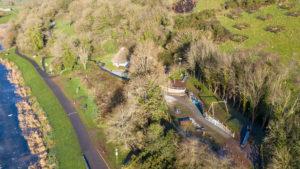

Lough Gur is one of Ireland’s archaeological and historical gems.  The beautiful and enchanted lake lies 21 km south east of Limerick city. 


From the level surrounding countryside it unfolds in beauty its placid waters and rugged hills – a fairyland of stone circles, ancient habitation sites, megalith tombs, crannogs and castles. 


The local community now manage the Heritage Centre and can arrange tours of the area for you with an experienced local guide - please contact 087 2852022 or 061 385386 for more information. Please note that the Heritage Centre is currently closed for refurbishment until June 20th.


Click here for video of ice skating on Lough Gur Jan 7th 2010

Lough Gur Development i-Trails brochure
Download your free Lough Gur I-Trails to accompany the audio tour.Discover the history, mythology and culture of this fascinating heritage area through two unique tours.
Lough Gur iTrails brochure.pdf
Adobe Acrobat Document [370.4 KB]
Download
Lough Gur Development i-Trails brochure
Download your free Lough Gur I-Trails to accompany the audio tour.Discover the history, mythology and culture of this fascinating heritage area through two unique tours.
Lough Gur iTrails brochure.pdf
Adobe Acrobat Document [370.4 KB]
Download
Magical Lough Gur i-Trail MP3
Magical Lough Gur i-Trail
Enjoy the natural beauty of Lough Gur as you are guided along some 2km of gentle hillside and shoreline paths, while listening to many centuries of facts, fairy tales and fantasies associated with this magical area.
Magical Lough Gur ITrail MP3.mp3
MP3 Audio File [62.5 MB]
Download
Legendary Lough Gur i-Trail
Whether you hop on a bike, sit at a steering wheel or just go on "shanks' mare," you'll be blown away with the spectacular stories and sights that await you along this 4KM i-Trail!
Legendary Lough Gur iTrail MP3.mp3
MP3 Audio File [63.7 MB]
Download

The book 'The Farm by Lough Gur' re-launched June 2010

This is the view from the farm by Lough Gur. You may know Mary Carbery's book of the same name, a classic and atmospheric account of Irish rural life and local folklore.

The book 'The Farm by Lough Gur' written by Mary Carberry has been re-launched following much local interest. This true story is based on the life of Sissy O'Brien who lived on the farm at Lough Gur in the mid 19th century, as told to Mary Carberry. A fascinating account of ordinary domestic life in Ireland. Available at Ryans and Reardons at Holy Cross, Nagles Spar shop in Bruff and also available at the Honeyfitz theatre 087 285 2022. Price €15 per copy. Limited edition.

See for yourself, Check out some videos of Lough Gur historical sights!

No? can't be real? or is it?

If you were one of the fearless (or wished you were!!) who ventured onto the frozen Lough Gur lake, why not join the hundreds who would like to share their images and experiences of Lough Gur on Facebook?

Click here to find out more!!

click here to view

Knockfennel (the highest hill) rises to 531 feet above sea level and from its summit one looks across the plain of Limerick to the Paps of Dana, the Ballyhouras, the Galtee mountains, Slievenamon, the Silvermines, the hills of Clare and the mouth of the Shannon.

Click here for more stunning views of Lough Gur

Lough Gur tells the story of the pre-Celtic settlers who first came to the area over 5,500 years and continues to the present day in the people who still dwell and farm in the locality.  It is an archaeological site of outstanding significance.  A visitor centre was built in 1980 and uses the design of two of the excavated stone age houses as its plan.  The Centre houses a number of displays covering stone age and bronze age  implements, pottery and weaving.  A slide show gives a good overview.


The lake is now crescent shaped but this is mainly due to drainage works carried on in the middle of the 19th century.  The drainage works reduced the level of the water by about 3 metres and on the newly exposed lakeshore was found the many artefacts which directed archaeological interest to the area.